
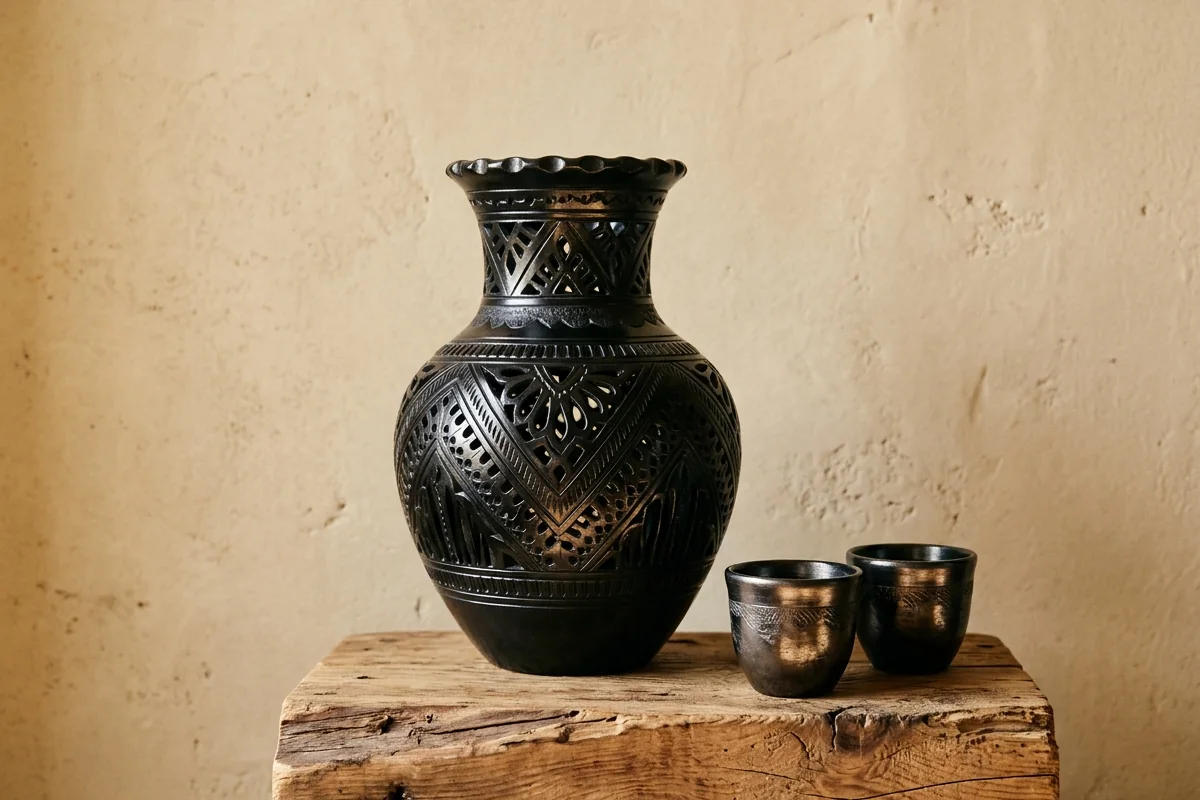
Quick Answer: Authentic Barro Negro from San Bartolo Coyotepec, Oaxaca contains zero black paint or glaze. Zapotec potters hand-form local gray clay on balanced clay saucers (moldes/parminas), polish leather-hard vessels with smooth quartz stones (a technique pioneered in the 1950s by Doña Rosa Real Mateo de Nieto), and seal wood-burning pit kilns with wet mud so carbon-rich smoke reduces iron oxide into gleaming metallic black.
| Editor’s Pick | Why We Recommend It | Availability |
|---|---|---|
| #1 Burnished FloreroDuelaguetza Handcrafted Oaxacan Florero Ovulo | Quartz-Polished Metallic Sheen · Hand-Formed | Check Amazon ↗ |
| #1 Mezcal Tasting SetSan Bartolo Oaxaca Black Clay Mezcal Copitas | Traditional Wide Rim · Agave Bar Essential | Check Amazon ↗ |
| #1 Rustic Matte VesselHandcrafted Oaxacan Black Ceramic Vase | Organic Smoke-Fired Texture | Check Amazon ↗ |
2,500 Years of Zapotec Gray-Black Utility Ware
Long before Spanish arrival, Zapotec and Mixtec potters in the Central Valleys of Oaxaca shaped local clay from San Bartolo Coyotepec into sturdy matte-gray water jugs (cántaros), mezcal storage vessels, and whistles. Instead of spinning mechanical foot wheels, Coyotepec artisans still use the pre-Hispanic parmina (balanced saucer wheel)—two shallow clay plates resting rim-to-rim that spin purely under the potter’s palm intuition.
Doña Rosa’s 1950s Discovery That Changed Mexican Fine Art
Traditional high-fired Coyotepec jugs were waterproof and utilitarian, but dull matte gray. In the early 1950s, master potter Doña Rosa Real Mateo de Nieto discovered that if she rubbed the nearly dry clay vigorously with a curved quartz crystal stone and pulled the firing slightly cooler (~700–800°C) inside a sealed oxygen-deprived horno de dos bocas (two-mouth underground pit kiln), the compressed clay emerged looking like polished black silver.
While the lower firing temperature meant vessels were no longer watertight for hauling river water, fine-art collectors from New York to Mexico City fell in love overnight—transforming San Bartolo Coyotepec into one of Latin America’s premier sculptural pottery capitals.
4 Signature Techniques You’ll Spot on Fine Pieces
- Bruñido (Quartz Burnishing): Weeks after shaping, before complete drying, the artisan rubs every curve with quartz to align microscopic clay platelets like mirror tiles.
- Calado (Lacy Openwork Piercing): Using homemade metal blades and thorns while the clay is leather-hard, potters pierce intricate diamond, floral, and bird cutouts without collapsing thin walls.
- Matte-vs.-Gloss Contrast: Leaving carved grooves unburnished while polishing raised ribs creates dramatic two-tone charcoal-and-silver geometry from a single clay body.
- Reduction Pit Firing: After hours of wood firing, every air vent is packed airtight with damp earth and mud for 12+ hours so oxygen-starved smoke forces red ferric oxide ($Fe_2O_3$) to reduce into black magnetite ($Fe_3O_4$).
Collector Care Rules
| Care Question | What to Do |
|---|---|
| Fresh Cut Flowers? | Never pour water straight into decorative Barro Negro; hide a narrow glass vase or test tube inside the neck |
| Dusting & Cleaning? | Wipe gently with a dry, lint-free microfiber cloth—never use Windex, furniture wax, or wet sponges |
| Direct Sunlight? | Indoor window light is fine, but keep low-fire black clay out of outdoor rain and lawn sprinklers |
Frequently Asked Questions
Can you drink mezcal out of Barro Negro copitas?
Only if the copitas are specifically high-fired or lined with a vitrified food-safe interior glaze (like the mezcal sets in our roundup)! Unlined low-fire decorative miniatures will absorb spirit and soften.
Why do black smudges rub off on my fingers from a cheap souvenir?
If black pigment rubs onto a white tissue, a dishonest vendor rubbed shoe polish or graphite wax onto under-fired clay! Real reduction-fired Barro Negro never bleeds black dye onto dry hands.
Can you visit Doña Rosa's family workshop in Oaxaca today?
Yes—her descendants still run the historic Taller Alfarería Doña Rosa in San Bartolo Coyotepec, roughly 25 minutes south of Oaxaca City, offering live parmina-shaping and quartz-burnishing demonstrations.
Ready to Compare the Best Handcrafted Options?
Explore our side-by-side glaze, size, and safety breakdown in our flagship buyer’s guide:
6 Best Authentic Oaxacan Barro Negro Vases & Mezcal Copitas →